
Home / Journal / Fire Pits and Outdoor Heating: What Actually Works
Outdoor heating
Fire Pits and Outdoor Heating: What Actually Works
A good outdoor kitchen or garden room earns its keep from April to October without any help. Add the right heat source and that stretches into November, sometimes later, with evenings round the table rather than evenings cut short by the cold. Wood-burning gives the best atmosphere and the most heat per pound spent, but it isn’t always practical built into a kitchen setting; gas is the most convenient and the most controllable; bioethanol is the cleanest and the easiest to retrofit, but the weakest heater of the three. Here is what actually works, and where we build each one in.
9 minute read · Updated October 2026
Wood-burning vs gas vs bioethanol: the real trade-offs
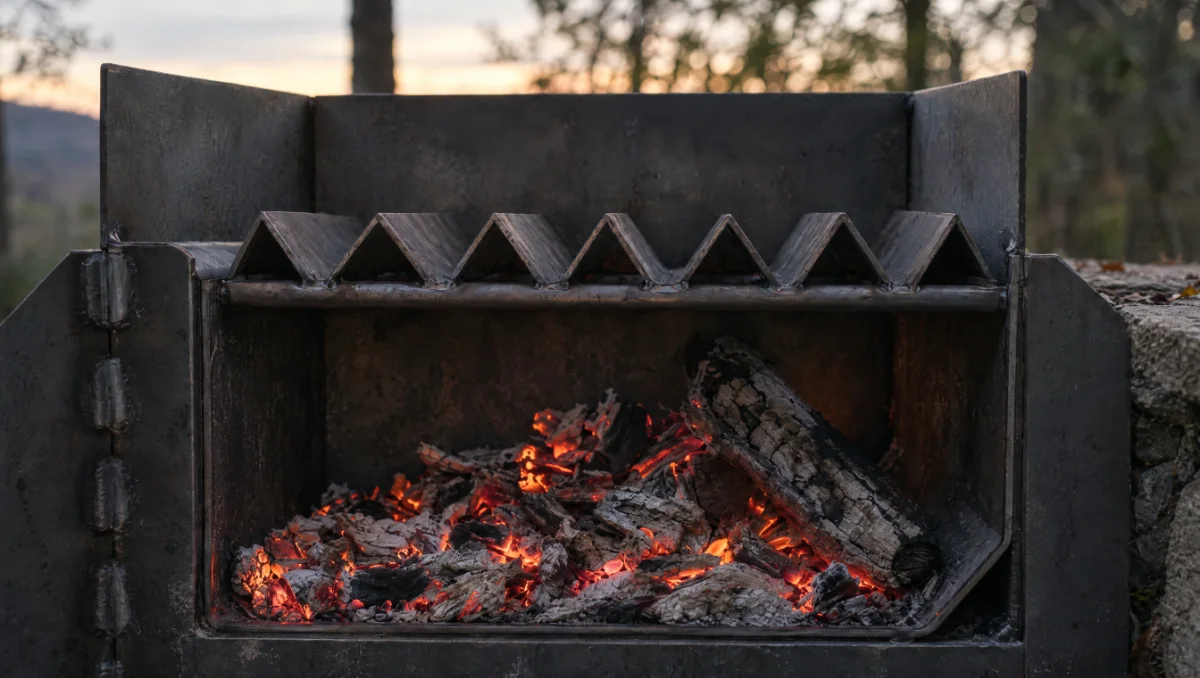
Wood-burning fire pits and chimineas produce more usable heat than almost anything else you can put in a garden, and nothing matches the crackle and smell of real logs. The trade-off is mess and tending — you need dry, seasoned wood stored somewhere dry, you are feeding it through the evening, and the ash and spent embers need dealing with before the covers go back on. We fit wood-burning pits most often as a freestanding feature a few metres from the kitchen or room itself, not built into the worktop run, because the smoke, spitting embers and radiant heat they throw make them a poor neighbour for a seating area or soft furnishings under a roof.
Gas fire pits and fire tables — running on propane from a hideaway bottle, or piped natural gas where it is already on site — are what most of our outdoor kitchen clients choose for anything built into the kitchen itself or the room around it. Push a button, get instant heat, turn it off the moment you do not need it, and there is no ash, no smoke and nothing to tend through the evening. Running cost is the highest of the three on a like-for-like basis, and a built-in gas fire table needs proper installation, Gas Safe registered where that applies, which we coordinate as part of the commission rather than leaving you to arrange separately.
Bioethanol burners sit at the opposite end: no flue, no gas supply, and no real smoke, which is why they are the only one of the three we will build directly into a worktop or a feature wall under a covered pavilion roof without additional ventilation work. The trade-off is heat output — a bioethanol burner takes the edge off a cool evening rather than genuinely heating a space, and running cost per hour is the highest of the three fuels pound-for-pound, since bioethanol itself is not cheap. It suits a smaller terrace or a feature alongside a kitchen better than it suits a family that wants real heat on a November evening.
| Fuel type | Heat output | Running cost | Fits into a kitchen build? |
|---|---|---|---|
| Wood-burning | Highest | Lowest | Freestanding, set apart |
| Gas | High, instant | Highest | Yes — built into island or table |
| Bioethanol | Low to moderate | High per hour | Yes — worktop or feature wall |
Building a fire pit into a Fire & Oak kitchen or room
Where a fire source sits depends on the fuel as much as the layout. A recessed gas fire table works well set into the end of an island, opposite the cooking run, so the group naturally splits between the person at the grill and everyone else keeping warm. On a corner kitchen we often set it into a low wall at the open end of the terrace instead, so it reads as a separate gathering point rather than competing with the worktop for space.
Inside a Fire & Oak outdoor room or pavilion, bioethanol is almost always the better fit if the fire needs to live under the roofline, built into a feature wall or a low hearth unit away from the kitchen counter. A wood-burning pit, by contrast, we will only ever site outside the covered structure, clear of the roof overhang and any timber cladding, as a separate feature on the open lawn or terrace beyond it. Wind direction matters more than most people expect: we try to position any open flame so prevailing wind carries smoke and sparks away from seating and from the building, not across it, which is as much a comfort decision as a safety one.
Sightlines are worth thinking about at the design stage, not after. A fire feature set at the far end of a run draws people past the kitchen rather than around it, which tends to keep the cook in the conversation instead of isolated at one end. If heating is part of the brief from the start, we draw it into the CAD plan alongside the appliances, so clearances, gas runs and sightlines are all resolved before anything is built, not retrofitted once the kitchen is finished.
Safety and clearance: what actually matters
Every fire appliance we specify, whether it is a gas fire table, a bioethanol burner or a wood-burning pit, comes with a manufacturer’s minimum clearance from combustible material, including timber decking, fencing, oak cladding and roof structures. We work to those figures as an absolute minimum and usually build in more, because a clearance distance on a spec sheet assumes still air and normal use, not a gusty Suffolk evening. Under a covered pavilion or outdoor room roof, an open-flame appliance also needs enough ventilation that smoke and heat do not build up against the underside of the structure, which is one of the main reasons we steer open wood-burning away from anything with a roof over it.
Gas installations need to meet current Gas Safety (Installation and Use) Regulations, and any fixed gas supply to a fire table or outdoor appliance should be connected by a Gas Safe registered engineer — something we coordinate as part of a commission where gas forms part of the design. Whether a fire feature itself needs planning permission depends on its size, position relative to boundaries, and whether it forms part of a larger structure being built at the same time; we are not able to give a blanket answer for every garden, and would always recommend checking the specifics with your local planning authority before committing to a design. Our separate guide on planning permission for outdoor kitchens covers the questions worth asking before you enquire.
A few practical habits matter regardless of fuel type: keep a means of extinguishing nearby (a lid for a bioethanol burner, a hose or bucket of sand for wood), never leave an open flame unattended with children or pets near the terrace, and site any appliance well clear of overhanging branches, parasols or anything else that could catch a stray ember or drift of heat.
Keeping it working through the seasons
Wood-burning pits need the most attention. Ash should be cleared once it has fully cooled, ideally after every few uses rather than left to build up, since wet ash sitting against a steel bowl or stone surround will shorten its life. A breathable cover between uses keeps rain out without trapping condensation underneath, and a solid-fuel pit left uncovered all winter will corrode or stain stonework faster than one that is looked after.
Gas fire tables are lower maintenance day to day but benefit from an annual service in the same way a boiler does — checking the burner, the jets and the connection for wear before the season starts, particularly if the appliance has sat unused over winter. Lava rock or glass media should be lifted out and rinsed occasionally, since dust and debris can affect how evenly the flame spreads across the burner.
Bioethanol burners are the simplest to maintain: wipe the burner tray clean of any residue after use, store spare fuel in its original sealed container somewhere cool and out of direct sun, and check the wind guard or flame control mechanism is moving freely before each season. Whatever the fuel, the oak surround or worktop it sits in benefits from the same winter care as the rest of the kitchen — a breathable cover and, for anything left exposed over the coldest months, an oil or wax top-up in spring.
Which option suits which garden
There isn’t a single right answer, and most of it comes down to how you actually use the space rather than which fuel sounds nicest in theory. A family that eats outside most weekends through summer and wants to keep doing that into autumn, without anyone minding smoke drifting over the table, tends to settle on gas built into the kitchen island — it goes on the moment the first course is ready and off the moment everyone’s gone inside, with none of the planning a wood fire needs.
A garden used more for entertaining in the evening — drinks round a fire rather than food at a worktop — often suits wood-burning better, sited a little apart from the kitchen where the smoke and the spectacle both have room to do their job. It asks more of you in return: stacking and seasoning logs, tending the fire through the evening, and clearing it out the next day, but for many clients that ritual is exactly the point of having one.
Bioethanol earns its place in smaller gardens and under cover, where a full fire pit isn’t practical and a gas supply isn’t already on site. It won’t replace a patio heater on a properly cold night, but as a feature alongside a kitchen, built into a low wall or a worktop end, it adds warmth and atmosphere without any of the ventilation or clearance questions an open flame raises. If you’re torn between two options, tell us how late into the year you actually want to be using the space, and how much tending you’re willing to do for it — that question narrows the choice faster than comparing specification sheets.
Before you enquire
A few things people usually ask
Can I add a fire pit to an outdoor kitchen or room we already have?
Usually, yes. A freestanding wood-burning or gas fire pit can often be added without touching the existing structure. Building a gas fire table or bioethanol feature into an existing worktop or wall is more involved, since it may mean cutting into oak or stone already fitted, so we would want to see the original design and visit site before confirming it is practical.
Which fuel type extends the season longest?
Wood-burning and gas both throw enough heat to keep a table comfortable into November in most gardens; bioethanol takes the edge off a mild evening but will not do much against a genuinely cold one. If late-season use matters most to you, we would usually steer you toward gas for convenience or wood for atmosphere, over bioethanol.
Do I need planning permission for a fire pit?
It depends on size, position and whether it is part of a larger structure, and we are not able to give a blanket answer that applies to every garden. We would always recommend checking with your local planning authority before finalising a design, particularly near a boundary. See our separate guide on planning permission for outdoor kitchens for the questions worth raising.
How much clearance do I need from the house or a pavilion roof?
Every appliance comes with a manufacturer’s minimum clearance from combustible material, which we treat as a floor rather than a target and usually exceed. Under a covered roof we specify enclosed-flame appliances such as gas or bioethanol rather than open wood-burning, and we build the ventilation and clearance into the CAD drawing before anything is fitted.
Tell us how you’d like to use the space through autumn and winter, and we’ll draw the heating into the design from the start.
See the kitchens · See the outdoor rooms · Start a commission
The Reeve & Co Group
Five names, one workshop

Bespoke joinery and interiors

Bespoke English kitchens

Made-to-order English furniture

Gun cabinets and sporting storage

Traditional and period bathrooms
Send us a photograph of the garden and what you like to cook.
We reply with a first idea, a guide price and a date to come and see it.

Stonham Road, Mickfield
Stowmarket, Suffolk IP14 5LS
01449 710500
hello@fireandoakoutdoors.co.uk
Make
Reeve & Co Square & True Bryn Hall Sporting Cabinetmakers Old Fashioned Bathrooms
Fire & Oak Outdoors is a trading name of Reeve & Co Interiors Ltd, registered in England and Wales no. 09593800.