
Home / Journal / The Case for Green Oak
Timber guide
The Case for Green Oak
Every oak frame that leaves our Mickfield workshop goes up green — sawn and jointed within weeks of felling, with the moisture still in the timber. That is not a shortcut. Green oak moves, splits along the grain and changes colour in ways that unsettle first-time clients until we explain what is actually happening. Here is why we frame structural outdoor rooms this way rather than switching to kiln-dried stock, what the movement you will see in year one means for strength, and how the grey patina develops over the following few years.
9 minute read · Updated October 2026
What “green oak” actually means
Green oak is simply freshly sawn oak that has not been artificially dried. Straight off the saw, English oak can hold moisture at somewhere around 60–80% of its dry weight, compared with the 18–20% that a kiln aims for in furniture-grade timber. We buy our structural sections from English sawmills and have them in the workshop within a few weeks to a few months of felling, long before that moisture has had any chance to leave the timber.
This is not a modern cost-cutting measure. English oak framing — the barns, the cruck-framed cottages, the Tudor timber houses still standing across Suffolk — was built green for the simple reason that oak of any real section size is extremely difficult to dry artificially without damaging it. A 200mm post dried in a kiln can take years to reach an even moisture content right through its core, and the stress of forcing that drying often causes deep internal splits, or even collapse of the fibres, long before the timber is usable. For the heavy sections an outdoor room frame needs — posts, tie beams, wall plates — green is, in practice as much as tradition, how oak of that scale has always been worked.
Why we frame in green oak rather than kiln-dried
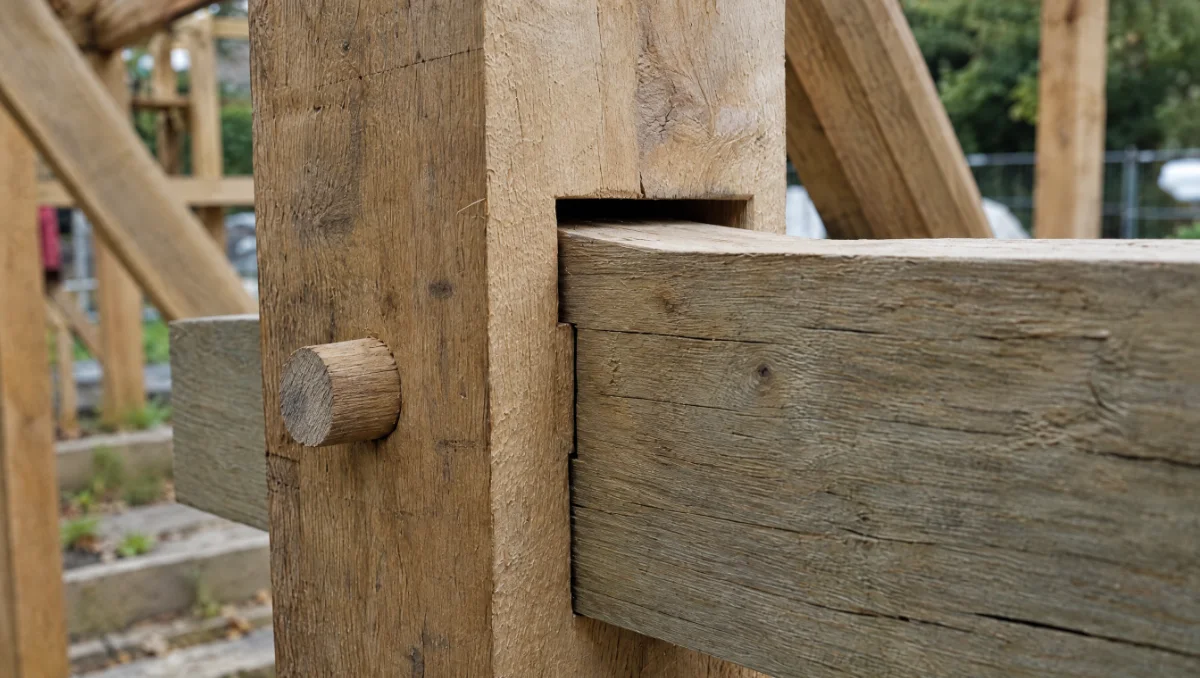
The main reason is the joints, not the posts. Green oak is soft and workable with hand tools and chisels in a way seasoned oak is not, which lets our joiners cut tight traditional mortice-and-tenon joints and pin them with oak pegs rather than relying on steel fixings. As the timber dries over its first one to three years outdoors, it shrinks slightly around those pegs and the joint tightens itself — the opposite of what happens with many modern bolted or glued connections, which can work loose as timber moves. A frame pegged green and left to season in place gets stronger, not weaker, through its early life.
There is also a straightforward supply issue. Kiln-dried oak is readily available in the smaller sections used for furniture and worktops, but large structural sections dried right through to a stable moisture content are genuinely scarce in the UK, slow to produce, and command a significant premium over green stock when they can be found at all — details we are happy to talk through at enquiry if a client specifically wants to explore it. For a structural garden frame, where some natural movement is expected and designed for, we do not think that premium buys you anything useful.
How checking happens, and why it is not a defect
The feature that alarms clients most in the first year is checking — the long splits that open up along the length of a post or beam as it dries. These are not cracks in the sense of something breaking; they are a natural consequence of oak drying from the outside in. The surface of the timber loses moisture and shrinks faster than the still-wet core, and the resulting tension releases itself along the grain in one or two long, straight splits rather than as a random pattern across the face.
Because checking runs with the grain rather than across it, it does not cut through the fibres that carry the load along a post or beam. A frame is designed around this from the outset: our joiners orient posts so that any checking develops on the least visible faces where possible, and the structural calculations for a green oak frame already assume this movement, rather than treating it as something that has gone wrong. Walk into any oak-framed barn built two hundred years ago and you will see exactly the same checking, in a building still doing its job.
What we do watch for, and what any reputable green oak joiner should, is the difference between surface checking and a genuine structural split running through a joint or a knot that has opened up badly. That is rare, and it is exactly why we grade and select the timber ourselves before it reaches the bench, rather than buying in pre-cut sections sight unseen.
Green oak against kiln-dried oak, side by side
For the structural frame of an outdoor room, the two options behave quite differently in the years after installation:
| Factor | Green oak | Kiln-dried oak |
|---|---|---|
| Moisture at installation | High — still drying in situ | Low — pre-dried to roughly 18–20% |
| Movement in first 1–3 years | Noticeable checking and some twist | Minimal, movement mostly complete already |
| Joint behaviour over time | Pegged joints tighten as timber shrinks | Joints set at installation, little further tightening |
| Availability in large sections | Readily available from UK sawmills | Scarce, longer lead times |
| Typical cost for structural sections | Standard — the norm for framing | Premium — discussed at enquiry |
| Working with hand tools | Soft, easy to cut tight joints | Harder, more tool wear |
Kiln-dried oak has its place — it is what we specify for worktop edging, smaller carcase components and anywhere dimensional stability matters more than cost or character. For the posts, beams and rafters that carry the roof of a garden room or pergola, green oak remains the practical and the traditional choice.
Living with green oak: what to expect, year by year
Maintenance on a green oak frame is lighter than most clients expect, precisely because we leave the timber untreated and let it season and silver naturally rather than fighting that process with coatings. There is no annual oiling or staining regime to keep up with. The two things worth planning for are practical rather than cosmetic.
- A fixings check after the first summer. Where a frame combines pegged joints with any bolted connections — typically at fixings into masonry or steel rather than the oak-to-oak joints themselves — we recommend checking those fixings are still snug once the timber has been through its first full drying season, and we build this into our aftercare conversation at handover.
- Tannin staining in the first wet season. Fresh oak releases tannins when it is repeatedly wetted, which can leave dark streaks on pale paving, stonework or render directly beneath the frame feet for the first six to twelve months. We discuss base detailing — padstones, lead shoes or a simple gravel margin — at the design stage for exactly this reason, and it settles down well within the first year as the surface dries out.
Beyond that, an untreated green oak frame is genuinely low-maintenance: no repainting, no annual varnish, nothing to flake or peel. If a client wants to slow the greying and keep a warmer, honey tone for longer, there are UV-stable oak oils that can be applied and need periodic reapplication — we can quote for this as an optional extra, though the great majority of our clients choose to let the timber do what oak has always done outdoors.
The silvering timeline: honey-gold to driftwood grey
Freshly erected, a green oak frame is a pale biscuit-honey colour, almost blonde where the timber has been freshly planed. What happens next is driven by sunlight and rain, not by time alone, so the pace varies with exposure. On faces that take direct sun and weather — typically south- and west-facing elevations — the first grey patches usually appear within a matter of months, starting as a faint silvering on the outermost surface fibres where UV breaks down the lignin.
By twelve to eighteen months most exposed frames show an uneven, patchy grey across the weathered faces, with warmer tones still visible in sheltered corners and under eaves. A fully even, soft silver-grey patina across the whole structure generally takes somewhere in the region of two to three years outdoors in the UK, and can take considerably longer on faces that are sheltered from direct rain and sun — the underside of a deep roof overhang, for instance, may stay honey-toned for years after the rest of the frame has turned. This unevenness is normal and, in our experience, is part of what makes a green oak structure look settled into a garden rather than uniformly stained.
The grey layer itself is a thin, weathered surface skin, not decay — underneath it the oak remains sound, which is precisely why so many centuries-old oak-framed buildings in Suffolk show exactly this silvered finish on timber that is still structurally doing its job.
Before you enquire
A few things people usually ask
Will the splits let water in and rot the frame?
Checking runs along the grain, not across it, so the splits do not open a path for water to track into the heart of a post or beam. Oak is also naturally durable and rot-resistant, which is part of why it has been the default UK framing timber for so long. We detail joints and base connections to shed water away from end grain and joint faces, which is where any timber is genuinely vulnerable.
How long before the frame is fully grey?
Somewhere in the region of two to three years for an even patina across an exposed frame, though it starts within months on the faces that get the most sun and rain. Sheltered faces, such as timber under a deep roof overhang, can stay honey-toned for considerably longer.
Can I treat the oak to stop it going grey?
Yes — UV-stable oak oils can slow the colour change and keep a warmer tone, though they need periodic reapplication to stay effective, which adds an ongoing maintenance task. We can quote this as an optional extra at enquiry; most clients choose to let the frame weather naturally instead.
Does green oak need more maintenance than kiln-dried oak?
No. Once the timber has moved through its initial seasoning and we have checked any fixings after the first summer, an untreated green oak frame asks no more of you year to year than a kiln-dried one — in both cases the ongoing maintenance is minimal if you are happy to let the oak weather naturally.
Send us a sketch of the space, and we will talk you through how a green oak frame would season into your garden.
The Reeve & Co Group
Five names, one workshop

Bespoke joinery and interiors

Bespoke English kitchens

Made-to-order English furniture
Gun cabinets and sporting storage

Traditional and period bathrooms
Send us a photograph of the garden and what you like to cook.
We reply with a first idea, a guide price and a date to come and see it.

Stonham Road, Mickfield
Stowmarket, Suffolk IP14 5LS
01449 710500
hello@fireandoakoutdoors.co.uk
Make
Reeve & Co Square & True Bryn Hall Sporting Cabinetmakers Old Fashioned Bathrooms
Fire & Oak Outdoors is a trading name of Reeve & Co Interiors Ltd, registered in England and Wales no. 09593800.