
Home / Journal / How Long Does It Take? Lead Times Explained
Planning your project
How Long Does It Take? Lead Times Explained
The honest answer: outdoor kitchens typically run 10–14 weeks from order to fitting, outdoor rooms 12–24 weeks, and Egg and kamado tables, Asado grills and Hearth fire tables at 16 weeks from order. Those are workshop-to-doorstep windows once a design is signed off and a deposit paid — they don’t include the weeks spent getting to that point. If you’re planning around a date, here’s what actually determines how long your project takes, and when to get in touch.
8 minute read · Updated October 2026
Lead times by product, in weeks
These are the ranges we quote once a design is agreed and a deposit is paid — they are not from the day you first get in touch. The design and quoting stage before that adds further time on top, which we cover below.
| Product | Typical lead time | Main variable |
|---|---|---|
| Outdoor kitchen | 10–14 weeks | Appliance lead times, worktop material |
| Egg & kamado table | 16 weeks | Egg size, worktop material |
| Outdoor room / pavilion | 12–24 weeks | Roof structure, glazing, groundworks |
A single-appliance Station kitchen with an in-stock grill tends to land at the shorter end of its range; a Banquet Kitchen with twin grills, a pizza oven and a wine cooler, or an outdoor room with a bespoke glazed gable end, tends to land at the longer end. We give you a specific figure for your project at quotation stage, not a generic range, once we know exactly what’s being built.
What actually moves the date
Three things account for almost all of the variation between a 10-week kitchen and a 14-week one, or a 12-week outdoor room and a 20-week one.
- Bespoke specification. Every job is drawn to the garden rather than pulled off a shelf, and the more non-standard the brief — an unusual run length, a book-matched worktop slab, a curved section, a bespoke glazed roof on an outdoor room — the more time it takes in design and in the workshop. A straightforward Station kitchen moves faster than a six-metre Banquet layout for this reason alone.
- Appliance lead times from manufacturers. We build the kitchen around the appliances, which means we are often waiting on a grill, pizza oven or refrigeration unit from a third-party manufacturer before the carcase can be finished to fit it. Popular models from Big Green Egg, Kamado Joe, Gozney and the major built-in grill brands are usually readily available, but a less common model, a specific colourway, or a manufacturer’s own backlog can add weeks that are outside our control. We flag any appliance with a longer lead time as soon as we know about it, rather than letting it surface as a surprise near the end.
- Seasonal workshop capacity. Enquiries cluster hard in spring, as everyone starts thinking about the garden at the same time. Booking in late winter for a spring or early-summer build gets you ahead of that queue; enquiring in April for a May garden party puts you up against everyone else who had the same idea, and our honest answer at that point may be a later date than you’d hoped for, not a rushed one.
Groundworks and services sit slightly outside this: if gas, power or water need bringing to the site, or a base needs laying before we can fit, that work usually runs in parallel with our build but needs coordinating, and a delay on that side can push a fitting date even once the kitchen itself is ready.
The full timeline: from first enquiry to first use
The 10–14 or 12–24 week figures above start from order, not from your first email. Before that, there’s a design and quoting stage that typically adds its own few weeks, depending on how quickly a site visit can be arranged and how much back-and-forth the drawing needs.
- Enquiry and site visit. We aim to get a site visit booked within a couple of weeks of first contact, sooner in quieter months.
- CAD drawing and quotation. Usually a week or two to produce a detailed drawing and fixed price, sometimes longer if the brief needs revisiting after the first draft.
- Deposit and order confirmation. The clock on the 10–14 or 12–24 week lead time starts here, once the design is signed off and the first stage payment is made.
- Manufacture. Built in our Mickfield workshop; this is the bulk of the lead time, and where appliance lead times and specification complexity bite.
- Delivery and fitting. Carried out by our own team, usually over one to a few days depending on scale.
Added together, a straightforward kitchen can realistically go from first enquiry to first use of the grill in around 14–18 weeks; a more complex outdoor room, allowing for groundworks, can run to five or six months end to end. Neither figure is a promise for every project — it’s what the maths looks like when nothing unusual happens on either side.
Planning backwards from a target date
If there’s a date in mind — a summer garden party, a milestone birthday, simply wanting the kitchen ready for the first warm weekend of the year — the simplest way to plan is to work backwards from it rather than forwards from today. Take your target date, subtract the lead time for the product you want (14 weeks for an outdoor kitchen, say, to be safe rather than optimistic), then subtract a further three to four weeks for design and quoting, and add a buffer of two to three weeks for anything unforeseen on either side. For a kitchen wanted by the first weekend in July, that calculation points to enquiring no later than late February or early March, and ideally earlier given how much spring demand compresses the workshop schedule.
The single most useful thing you can do if a date matters is tell us at the first conversation, not partway through the quoting process. It changes how we specify the appliances — steering toward models we know are readily available over ones with a longer manufacturer backlog — and it lets us tell you honestly, at the outset, whether the date is realistic or whether the brief needs adjusting to hit it. We would always rather have that conversation in week one than discover a conflict in week ten.
Outdoor rooms carry the most timeline risk of the three product types, simply because more of the build — roof structure, glazing, sometimes a base or groundworks — sits outside a single, well-rehearsed workshop process. If a room needs to be ready for a specific event, we would recommend enquiring at least six months out rather than the three to four that can work for a kitchen.
What happens inside the lead time
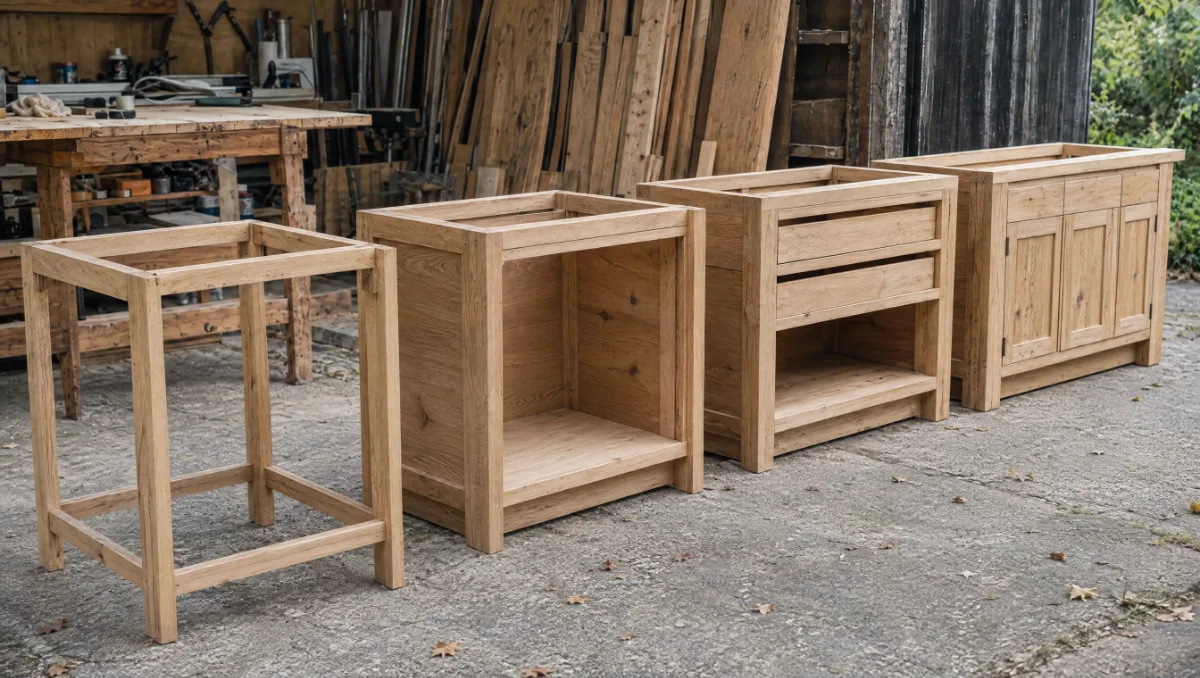
The quoted lead time isn’t a single block of waiting — it covers a sequence of real stages, and knowing what’s happening at each point helps explain why a kitchen can’t simply be built faster by asking. Once a deposit lands, the first few weeks go into finalising joinery drawings from the signed-off CAD design, ordering the oak and confirming appliance specifications and delivery windows with each manufacturer. Timber then needs to be prepared and, where solid oak sections are involved, allowed to settle before final jointing, which isn’t a step we skip under time pressure because it’s the difference between a worktop frame that stays true for twenty years and one that doesn’t.
The middle stretch of the lead time is the carcase build itself — cutting, jointing and assembling the structure, cutting housings for appliances and services, and fitting the worktop once it’s been templated and cut to size. Appliances are usually the last major component to arrive before final assembly, which is why a delayed grill or pizza oven can hold up the whole job even if every piece of joinery is finished and waiting. The final stage is quality checks in the workshop before delivery, followed by on-site fitting and a final walk-through with you once everything is connected and working.
We’d rather tell a client their kitchen will take 13 weeks and deliver on week 12 than promise 9 and deliver on week 14. If you want visibility during the build rather than silence until delivery, ask — we’re happy to give a rough progress update partway through manufacture, particularly on longer or more complex commissions.
Common timeline mistakes worth avoiding
The most common mistake is treating the enquiry date as the start of the lead time. It isn’t — the clock starts once a design is agreed and a deposit paid, and the design stage itself, especially for a more involved kitchen or an outdoor room, can run to several weeks on its own. If you want a kitchen fitted by a particular date, work back from that date using the order-to-fitting lead time, then add the design and quoting stage on top, not the other way round.
The second is specifying an appliance before checking its availability. A particular colourway of a popular grill, or a less common pizza oven model, can carry a manufacturer lead time well beyond our own, and if that isn’t flagged early it becomes the one thing holding up an otherwise-finished kitchen. We check availability at the quotation stage precisely so this doesn’t happen partway through a build, but if you have your heart set on a specific model, it’s worth asking us to check it before you fall in love with the idea.
The third is leaving groundworks until after the kitchen or room arrives. Paving, bringing gas or power to the site, and laying a base all need to be finished, or at least scheduled to finish, before our fitting date, not started once the kitchen is delivered. We flag what needs to be ready on your side as part of the quotation, so there’s a clear list to work from well before delivery week.
Before you enquire
A few things people usually ask
Can you rush a project for an event?
Sometimes, within limits. The main lever is appliance choice — specifying a grill or oven we know is readily in stock rather than one on manufacturer backorder can save real time. What we won’t do is compromise the joinery or the fitting to hit a date; if the honest lead time doesn’t fit, we’ll tell you at quotation stage rather than over-promise.
When should I enquire for a summer garden party?
For an outdoor kitchen or egg table, aim to enquire by late winter — January or February — for a summer event, since spring is our busiest quoting period and the queue lengthens fast. For an outdoor room, we’d suggest six months out as a safer starting point given the extra groundworks and structural elements involved.
Does the lead time include groundworks like paving or bringing in services?
No. Our quoted lead times cover design, manufacture, delivery and fitting of the kitchen or room itself. Bringing gas, power or water to the site, and any paving or base preparation, is usually arranged separately with your builder or ours, and needs coordinating alongside our schedule rather than being folded into it.
What happens if an appliance is delayed by the manufacturer?
We flag any known manufacturer delay as soon as we’re aware of it, rather than near the fitting date. Where it’s within our control we’ll suggest an in-stock alternative; where it isn’t, we’ll give you a realistic revised date rather than a guess.
Tell us your target date and we’ll give you an honest read on whether it’s achievable, before you commit to anything.
The Reeve & Co Group
Five names, one workshop

Bespoke joinery and interiors
Bespoke English kitchens
Made-to-order English furniture
Gun cabinets and sporting storage

Traditional and period bathrooms
Send us a photograph of the garden and what you like to cook.
We reply with a first idea, a guide price and a date to come and see it.

Stonham Road, Mickfield
Stowmarket, Suffolk IP14 5LS
01449 710500
hello@fireandoakoutdoors.co.uk
Make
Reeve & Co Square & True Bryn Hall Sporting Cabinetmakers Old Fashioned Bathrooms
Fire & Oak Outdoors is a trading name of Reeve & Co Interiors Ltd, registered in England and Wales no. 09593800.