
Home / Journal / Iroko vs Oak: Choosing Your Outdoor Kitchen Timber
Timber guide
Iroko vs Oak: Choosing Your Outdoor Kitchen Timber
We build outdoor kitchen carcases in two timbers: English oak and Iroko. Both are durable enough to sit outside year-round in an English climate, but they move, weather and age differently, and the right choice depends on the look you want and how the kitchen sits against the house. Here is what actually separates them, so the decision at your design meeting is an informed one rather than a guess.
8 minute read · Updated October 2026
Two timbers, one job
An outdoor kitchen carcase has to do something most outdoor joinery does not: sit directly behind a working grill, hold a stone or composite worktop dead level for years, and shrug off rain, frost and the occasional splash of marinade without the doors and drawers binding. Iroko and oak are the two hardwoods that meet that brief reliably in the UK climate, and they are both species we have worked with for years rather than materials we are experimenting with on a client’s project.
Softwoods, even treated ones, do not get specified for a carcase at this end of the market — they move more, rot faster at end grain, and simply do not carry the same weight of stone worktop with confidence over a ten-year horizon. Between Iroko and oak, the decision usually comes down to colour, cost and how much natural movement a client is happy to see in the first couple of years, which is what the rest of this guide sets out.
Durability: both are built for the outdoors, differently
Iroko is a West African hardwood that has been specified for exterior joinery, boat decking and window frames in the UK for decades precisely because of its natural durability — it sits in the same durability class as teak, with a high natural oil content that resists moisture uptake and makes it naturally resistant to rot and most wood-boring insects without any chemical treatment. It is also notably dimensionally stable once seasoned, meaning doors and drawer fronts stay true through seasonal humidity changes rather than sticking in summer and gapping in winter.
English oak is also a durable hardwood by any recognised standard, and has clad English buildings for centuries, but it behaves differently outdoors. Kiln-dried oak used in a kitchen carcase is more dimensionally stable than the green oak we frame structural outdoor rooms with, though it will still move slightly more than Iroko through the seasons, and it is more prone to releasing tannins when repeatedly wetted, particularly in the first year or two. Both timbers, properly detailed and finished, comfortably last decades outdoors — the difference is in how little or how much seasonal movement and tannin activity a client wants to see along the way.
Colour and finish: warm gold against honey oak
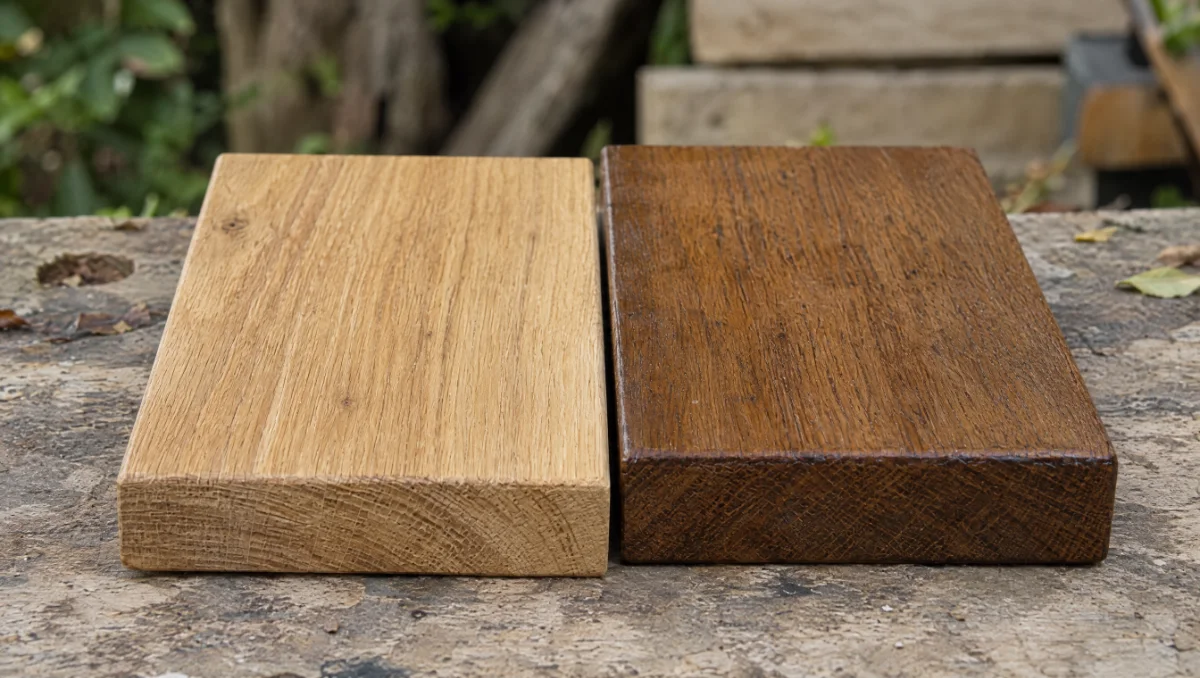
This is usually where the decision actually gets made. Freshly worked Iroko is a rich, warm gold-brown, sometimes with an orange cast, that reads as distinctly different from oak at close range — it has more visual weight and a denser, tighter grain pattern with less of the obvious figuring that oak shows. Left untreated outdoors, Iroko weathers to a silvery-grey over one to two years in a broadly similar way to oak, though the starting colour and the texture of the grain along the way are noticeably different.
Oak is the paler, honey-toned timber most people picture when they think of English joinery, with a more open, visible grain and the medullary ray flecking that shows clearly on quarter-sawn faces. It is also the timber that matches an existing oak-framed outdoor room, oak-clad extension or oak front door most convincingly, simply because it is the same species. If the kitchen needs to read as part of a wider oak scheme already on the property, oak is the straightforward choice; if it is a standalone piece and a deeper, richer tone suits the setting better, Iroko is worth seeing in person before deciding.
We keep sample sections of both in the workshop, and strongly recommend seeing and handling them side by side rather than choosing from a photograph — the colour difference between the two is real, but screens exaggerate it or flatten it out in different ways depending on lighting.
Cost and workshop time
Iroko generally carries a higher material cost than English oak for an equivalent carcase, reflecting import and supply chain factors for a timber that, unlike oak, is not grown domestically. It is also a denser, oilier timber to machine, which can add modestly to workshop time on fine joinery. Oak, sourced from English sawmills, sits at a lower material cost and is the timber we can usually turn around fastest for carcase components, since it is what the bulk of our bench work is set up around day to day.
Exact figures depend on the size of the kitchen, the finish specified and current timber market pricing, both of which move; we price this on a fixed quotation at the CAD stage rather than quoting a per-metre rate here, so there are no numbers to go out of date on this page — the cost difference between the two species on a typical commission is discussed plainly at enquiry.
| Factor | Iroko | English oak |
|---|---|---|
| Natural colour | Warm gold-brown, sometimes orange-cast | Pale honey-gold |
| Grain character | Tight, dense, less pronounced figuring | Open grain, visible medullary rays |
| Natural oil content | High — strong natural weather resistance | Moderate — still a durable hardwood |
| Dimensional stability | Very stable once seasoned | Good, slightly more seasonal movement |
| Tannin staining risk | Low | Higher, especially in year one |
| UK sourcing | Imported, West Africa | Grown and sawn in England |
| Relative material cost | Higher — price on application | Lower — price on application |
| Weathers to grey outdoors | Yes, over 1–2 years | Yes, over 1–2 years |
Maintenance: what each timber asks of you
Left untreated, both timbers are genuinely low-maintenance and will weather to a similar silver-grey over the first year or two outdoors, with no repainting or routine coating required. The practical differences in upkeep are narrower than most clients expect, but they exist:
- Iroko rarely needs anything beyond an occasional clean, thanks to its high natural oil content; it is also less prone to surface mould in consistently damp, shaded spots than most hardwoods.
- Oak can release tannins when repeatedly wetted in its first one to two years, which is worth planning for around pale paving or render directly beneath the kitchen — it settles once the surface has fully weathered.
- Both timbers can be oiled periodically if a client wants to hold the original colour for longer rather than letting it silver — this is genuinely optional maintenance, not something either timber requires to survive outdoors.
- Worktop and appliance seals matter more to long-term carcase condition than the choice of timber species; we detail both timbers the same way around grills, sinks and drainage points.
What the workshop recommends, and when
We do not have a house default between the two — the right answer depends on the project. We recommend oak when the kitchen needs to match an existing oak-framed outdoor room, oak extension or oak front door, when budget is a primary driver, or when the client likes the idea of a kitchen that visibly ages and silvers in step with other oak already in the garden. It is also our standard recommendation for clients building their first bespoke outdoor kitchen and wanting the most established, lowest-risk option.
We recommend Iroko when the kitchen sits as a standalone feature rather than matching an existing oak scheme, when a client wants a noticeably richer, deeper tone before weathering sets in, when the site is particularly exposed or damp and the extra natural oil content is worth the premium, or where very tight, stable joinery — minimal movement in doors and drawer fronts through the seasons — is the priority. Several of our coastal Suffolk and Norfolk commissions have specified Iroko for exactly this reason.
Either way, we talk this through at the site visit with sample sections in hand, against the actual stone or paving and the actual light the kitchen will sit in, before anything is specified on a drawing.
Before you enquire
A few things people usually ask
Is Iroko more expensive than oak?
Generally yes, reflecting that it is imported rather than grown and sawn in England. The exact difference depends on the size of the kitchen and current timber market pricing, so we quote it on a fixed basis at the CAD stage rather than a flat per-metre figure — price on application at enquiry.
Can I mix Iroko and oak in the same kitchen?
We generally advise against it for a single carcase, since the two timbers weather at slightly different rates and the colour contrast can read as mismatched rather than deliberate once both have silvered. If you like elements of both, it is worth discussing the specific look you are after at the site visit.
Will either timber match my existing oak-framed outdoor room?
Oak will, since it is the same species as the frame and will weather in a broadly similar way over time. Iroko reads as a distinctly different, richer tone even once weathered, so if matching an existing oak structure closely is the priority, oak is the straightforward choice.
Does either timber need chemical treatment to survive outdoors?
No. Both are naturally durable hardwoods and we do not chemically treat either for a standard outdoor kitchen carcase. An optional UV-stable oil can be applied periodically if you want to hold the original colour longer, but it is not required for the timber to last outdoors.
Come and handle both timbers in the workshop before you decide — we will show you sample sections against your own stone and paving.
The Reeve & Co Group
Five names, one workshop
Bespoke joinery and interiors

Bespoke English kitchens

Made-to-order English furniture
Gun cabinets and sporting storage

Traditional and period bathrooms
Send us a photograph of the garden and what you like to cook.
We reply with a first idea, a guide price and a date to come and see it.

Stonham Road, Mickfield
Stowmarket, Suffolk IP14 5LS
01449 710500
hello@fireandoakoutdoors.co.uk
Make
Reeve & Co Square & True Bryn Hall Sporting Cabinetmakers Old Fashioned Bathrooms
Fire & Oak Outdoors is a trading name of Reeve & Co Interiors Ltd, registered in England and Wales no. 09593800.