
Home / Journal / Comparing Outdoor Kitchen Worktops: A Full Guide
Materials guide
Comparing Outdoor Kitchen Worktops: A Full Guide
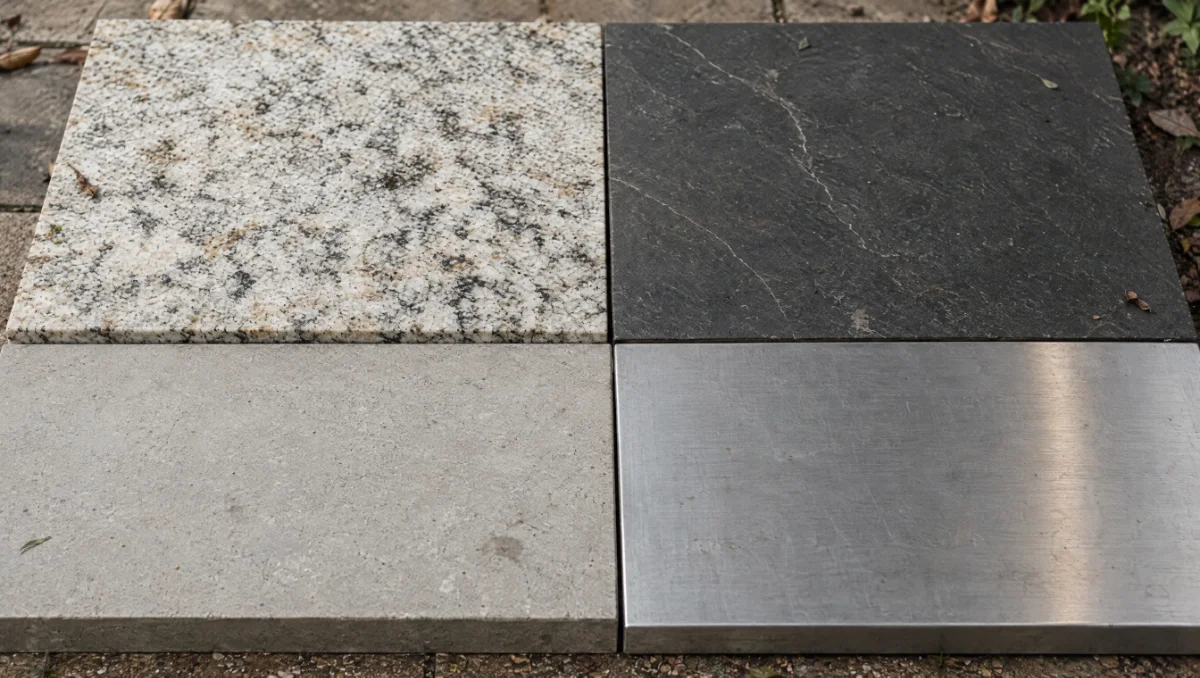
If you want the short answer: granite and Dekton (sintered stone) are the two materials we fit most often, honed marble is the one that needs the most honest conversation before anyone commits to it, and large-format porcelain has closed much of the gap on both at a typically lower cost band. Below is how the four actually behave outside — frost, staining, heat straight off a grill, and what they cost and need to maintain — not the showroom version.
9 minute read · Updated October 2026
Why an indoor worktop comparison doesn’t transfer outside
A kitchen worktop indoors mostly has to resist knives, hot pans and the odd glass of red wine. Outside, in a Suffolk or Norfolk garden, it has to do all of that plus survive rain sitting on the surface overnight, freeze-thaw cycles through a damp winter, direct UV through a long summer, falling leaves and tree sap left unnoticed for weeks, and heat radiating from a grill or pizza oven set directly into it. Those extra stresses are why a material that performs beautifully in a show kitchen can disappoint within two winters outdoors, and why the right choice depends on four specific properties rather than how a slab looks in a showroom under gallery lighting.
We judge every worktop material against the same four criteria on every commission: frost resistance (how the material copes with water sitting in its pores through a freeze), staining resistance (oil, wine, tannin from leaves, barbecue smoke), heat resistance (what happens when a hot pan, grill plate or ember sits directly on the surface), and ongoing maintenance (sealing, cleaning, what happens if it is neglected for a season). This guide covers all four materials against all four criteria. If you specifically want the detail on frost and winter performance, our companion piece, which worktops survive an English winter, goes deeper on that one factor alone; this article is the broader buying-guide comparison.
Granite: the default for a reason
Granite remains the material most clients start with, and it earns that position. It is a dense natural stone with very low water absorption once properly sealed — typically under 0.4% by weight for a good-quality slab — which gives it strong frost resistance for a UK garden, where we see perhaps a handful of hard freeze-thaw cycles through an average winter rather than the sustained deep freezes of a continental climate. Heat resistance is good: granite shrugs off the warmth radiating from a lit grill, though a hot cast-iron pan lifted straight off a flame and set down on a cold, rain-soaked slab can cause thermal shock and hairline cracking in rare cases, which is why we still recommend a trivet for anything coming straight off direct heat.
Staining is the area that catches people out. Granite is porous at a microscopic level, and an unsealed or poorly sealed slab left outdoors will pick up tannin stains from fallen leaves, oil marks around a grill station, and green algae bloom in shaded, damp corners faster than the same stone would indoors. A quality penetrating sealer reapplied roughly every 12–18 months outdoors (more often in shaded, north-facing positions) keeps this in check; neglect it for two or three seasons and staining becomes visible and harder to lift. Cost typically sits in the mid-range of the four materials covered here, varying with colour, slab size and edge profile — exotic colours and book-matched pairs cost more than a standard granite in a common colourway. As with any material on a Fire & Oak commission, we quote the actual slab and edge detail you choose rather than a generic figure, and happily talk through the current range at enquiry.
Dekton and sintered stone: the low-maintenance choice
Sintered stone — Dekton is the name most clients recognise, alongside similar products from other manufacturers — is engineered rather than quarried, made from a blend of the raw materials found in glass, porcelain and quartz surfaces, compacted and fired under extreme heat and pressure. The result is a surface with near-zero porosity, which translates directly into excellent frost resistance and staining resistance: there is very little for water, oil or wine to penetrate in the first place, and most spills wipe off a Dekton surface with soap and water even if left overnight. It does not need sealing, which is the single biggest maintenance saving over natural stone across the life of an outdoor kitchen.
Heat resistance is the best of the four materials here; a sintered worktop will generally tolerate a hot pan set directly on the surface without marking, though we still advise against habitually resting anything scorching straight from an open flame on any worktop, sintered stone included, since sustained direct contact with extreme heat can still cause localised discolouration over time. UV stability is excellent too, so colour does not fade or yellow over years in full sun, which matters on a south-facing terrace. The trade-off is cost: sintered stone typically carries a premium over granite, often in the region of 15–25% more for a comparable specification, and very thin-format slabs can be vulnerable to edge chipping on impact if not detailed and supported correctly during fabrication — something a bespoke build like ours accounts for at the drawing stage rather than leaving to a standard template.
Honed marble: beautiful, but not an easy outdoor material
We fit honed marble outdoors occasionally, and we are direct with clients about what that choice involves before they order it. Marble is a softer, more porous stone than granite, and a honed (matte, lightly ground) finish is more porous again than a polished one, because polishing partially seals the surface pores that honing leaves open. That combination makes marble the most vulnerable of the four materials to both staining and etching — acidic splashes from lemon, wine or vinegar dull the surface permanently within seconds, not hours, and no sealer fully prevents it, only slows it.
Frost performance is the weaker point outdoors specifically: water sitting in marble’s open pores through repeated freeze-thaw cycles can, over several winters, contribute to surface spalling or hairline fracturing, particularly at edges and around any cut-outs for sinks or hobs. Clients who want marble outdoors tend to fall into two groups: those building under a covered structure — a pergola, veranda or fully enclosed outdoor room — where exposure to standing rain and direct frost is much reduced, and those who accept and even like the idea of a living patina developing over the years, the way an old marble hearth or doorstep weathers. We would not recommend honed marble for a fully exposed, uncovered worktop sitting directly beside a grill in an open Suffolk garden, and we say so plainly rather than sell the look and let the winter be the one to tell the client. Cost typically sits at the upper end of the range, broadly comparable to or above sintered stone depending on the specific marble, and is always discussed at enquiry against the actual slab in question.
Porcelain: closing the gap
Large-format porcelain slabs, typically 12–20mm thick, are fired at very high temperatures and share much of sintered stone’s near-zero porosity, which gives porcelain similarly strong frost resistance, staining resistance and UV stability. It is noticeably lighter than natural stone of the same dimensions, which can simplify the carcase and substructure on a large island, and modern printed finishes reproduce stone and concrete looks convincingly from normal viewing distance, which is why it has become a serious contender rather than a budget substitute.
Cost typically makes porcelain the most competitive of the four materials for a comparable specification, which is the main reason its popularity has grown quickly. The compromises are at the edges, literally: porcelain can chip on sharp impact more readily than a thick granite or sintered slab, so the edge detail — mitred, bullnose, or with a reinforcing strip — needs a fabricator who knows the material, and chip or crack repair is generally harder to disguise invisibly than on natural stone. Up close, a trained eye can sometimes spot the repeating pattern in a printed finish where a natural stone slab would show genuine random variation; most clients never notice this once the worktop is fitted and dressed with appliances either side of it.
Side by side
A simplified summary of the four, though every real commission deserves the fuller conversation above rather than this table alone:
| Material | Frost resistance | Staining resistance | Heat resistance | Typical cost band | Maintenance |
|---|---|---|---|---|---|
| Granite | Strong, when sealed | Good, needs sealing | Good, use a trivet for direct flame-hot pans | Mid-range | Reseal roughly every 12–18 months |
| Dekton / sintered stone | Excellent | Excellent | Excellent | Mid to upper, often +15–25% on granite | Minimal, no sealing required |
| Honed marble | Weakest of the four, best under cover | Weakest, etches easily | Good, but patina expected | Upper | Frequent resealing, patina accepted over time |
| Porcelain | Excellent | Excellent | Very good | Typically most competitive | Minimal, protect edges from impact |
On most commissions we end up recommending Dekton or granite for a fully exposed run next to the grill, porcelain where budget is the deciding factor and the look still needs to read as stone or concrete, and marble only where the kitchen sits under a roof, veranda or enclosed outdoor room — see our comparison of pavilions versus fully enclosed garden rooms if cover is part of your thinking. None of this is a fixed rule: the right answer depends on how exposed the specific spot in your garden actually is, how the kitchen will be used, and how much maintenance you are realistically going to do each spring.
How we help a client choose
We bring physical samples of all four materials to every site visit, because photographs and showroom lighting flatten the differences in texture and colour depth that matter once a slab is sitting in your actual garden light. We also ask about exposure before we ask about looks: is the spot fully open to the sky, under a pergola with gaps, or inside an enclosed outdoor room; does it face north and stay damp, or south and bake all summer; is it near overhanging trees that will drop sap and leaves onto the surface for months at a time. Those answers narrow the shortlist faster than any brochure, and they are the reason a fixed quotation from us always names the specific slab and edge profile rather than a generic material category, so you know exactly what you are agreeing to and what it costs before any deposit changes hands.
Before you enquire
A few things people usually ask
Does a worktop near a grill need special heat protection regardless of material?
Generally yes. We design in a clear service zone around every appliance and recommend a trivet or heat pad for anything lifted straight off direct flame, even on sintered stone or porcelain. It protects the appliance’s own housing as much as the worktop, and it is good practice on any material.
Can I mix materials, such as Dekton for the cooking run and granite elsewhere?
Yes, and we do this regularly — a harder-wearing material around the grill and sink, with a different stone or a timber surface further along for food prep or seating. We work it out at the drawing stage so the join sits somewhere sensible rather than through the middle of a usable surface.
How often does an outdoor granite or marble worktop need resealing?
As a general guide, roughly every 12–18 months for granite in a typical English garden, and more often for marble or for any slab in a shaded, damp spot. A quick water-drop test tells you if it is due: if water beads on the surface the seal is still working; if it soaks in within a minute or two, it is time to reseal.
Which material do you recommend for a kitchen with no cover at all?
For a fully exposed position we steer most clients towards Dekton, another sintered stone, or large-format porcelain, since both tolerate standing rain, frost and UV with very little upkeep. We would only recommend honed marble in a fully exposed spot if the client has already decided they are happy for it to weather and patinate over time.
Send us a photo of the space and tell us how exposed it is to weather, and we’ll bring samples of the materials actually worth considering.
The Reeve & Co Group
Five names, one workshop

Bespoke joinery and interiors

Bespoke English kitchens

Made-to-order English furniture

Gun cabinets and sporting storage

Traditional and period bathrooms
Send us a photograph of the garden and what you like to cook.
We reply with a first idea, a guide price and a date to come and see it.

Stonham Road, Mickfield
Stowmarket, Suffolk IP14 5LS
01449 710500
hello@fireandoakoutdoors.co.uk
Make
Reeve & Co Square & True Bryn Hall Sporting Cabinetmakers Old Fashioned Bathrooms
Fire & Oak Outdoors is a trading name of Reeve & Co Interiors Ltd, registered in England and Wales no. 09593800.